Master Information Block: The Powerful Gateway to LTE and 5G Network Access
How the MIB Helps Mobile Devices Discover, Synchronise With, and Enter Cellular Networks

Introduction
The Master Information Block is one of the smallest but most important messages transmitted by a cellular network. Before a smartphone can make a call, browse the internet, send messages, or use mobile applications, it must discover a nearby cell and understand its basic radio structure. The MIB provides the essential starting information for this process. It is broadcast repeatedly by an eNodeB in 4G LTE or a gNodeB in 5G NR so that user equipment, commonly known as a UE, can detect the cell and receive further instructions. Although the MIB contains only a limited number of parameters, every field has a clear purpose. Without successfully decoding it, a mobile device cannot continue the normal network-access procedure.
What Is the Master Information Block?
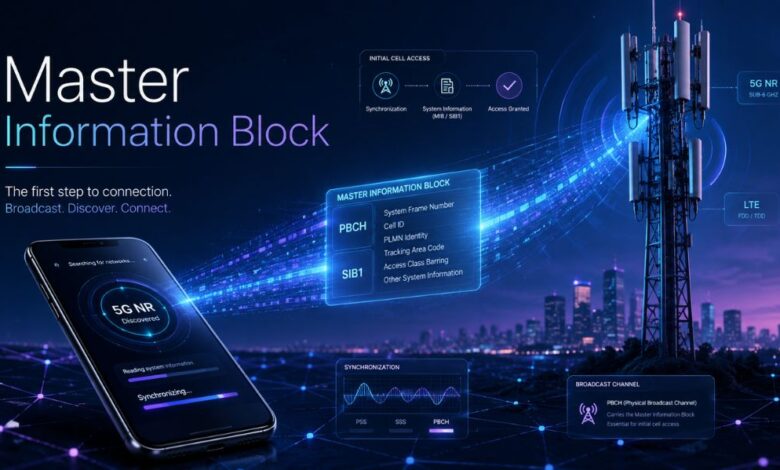
The Master Information Block is a basic system-information message carried through the Broadcast Channel and physically transmitted over the Physical Broadcast Channel, commonly called the PBCH. It is designed to be located and decoded soon after a mobile device completes the initial cell-search and physical-layer synchronisation process.
When a phone is switched on, leaves aeroplane mode, loses network coverage, or searches for a stronger cell, it scans the radio frequencies supported by the device. It detects synchronisation signals, identifies a possible serving cell, and attempts to decode the PBCH. The MIB then provides enough timing and radio-configuration information for the device to begin searching for System Information Block 1, also known as SIB1.
Why the Master Information Block Is Essential
The word “master” reflects the controlling role of the message during the earliest stage of network discovery. The MIB does not contain every detail about the cellular network. Instead, it provides the minimum foundation required to locate and decode the next layer of system information.
The Master Information Block therefore works as a bridge between initial radio-signal detection and complete system-information acquisition. It allows the device to move from simply recognising the presence of a cell to understanding how it should continue the connection process.
How the Master Information Block Is Broadcast
The Master Information Block is transmitted repeatedly because a cellular base station does not know when a new device will enter its coverage area. A phone can begin searching for a network at any moment, meaning the MIB must remain regularly available over the air.
The information moves from the Radio Resource Control layer through the Broadcast Control Channel and the Broadcast Channel before being transmitted through the PBCH. This standardised process delivers essential network information from the base station’s control system to nearby mobile devices.
Role of the PBCH in MIB Transmission
The PBCH is designed for reliable reception, even when a mobile device is far from the base station or operating in an area affected by interference. Successful PBCH decoding is extremely important because it gives the UE access to the MIB.
In LTE, the PBCH directly carries the LTE Master Information Block. In 5G NR, the PBCH forms part of a wider structure known as the Synchronisation Signal Block, or SSB.
Master Information Block and SSB in 5G
The 5G Synchronisation Signal Block contains the Primary Synchronisation Signal, Secondary Synchronisation Signal, and PBCH. This structure allows a device to establish timing, determine the physical cell identity, and decode the Master Information Block during the same cell-discovery process.
Because 5G networks may use directional beam transmission, several SSBs can be transmitted in different directions. This improves cell coverage and helps devices discover the strongest or most suitable beam for initial network access.
Master Information Block in 4G LTE
The LTE Master Information Block carries part of the System Frame Number, the downlink system bandwidth, and the Physical Hybrid ARQ Indicator Channel configuration. The System Frame Number helps the device align itself with the timing structure of the LTE network.
The downlink bandwidth information identifies the size of the LTE carrier resource grid. The PHICH configuration supports the interpretation of control signalling associated with LTE uplink transmissions. These parameters give the device the basic knowledge required to continue reading control information from the cell.
LTE Cell Search and MIB Decoding
During LTE cell search, the UE uses the primary and secondary synchronisation signals to establish radio timing and determine the physical cell identity. It then attempts to decode the PBCH and obtain the MIB.
The LTE MIB is intentionally compact, which improves the likelihood of successful reception under weak or difficult radio conditions. More detailed information, including network identities, access restrictions, tracking-area information, and scheduling instructions, is delivered through SIB1 and additional system information blocks.
Master Information Block in 5G NR
The 5G NR Master Information Block serves the same general purpose as the LTE MIB, but it supports the more flexible radio design of New Radio. It contains part of the System Frame Number, common subcarrier-spacing information, the SSB subcarrier offset, a demodulation reference-signal position indicator, and configuration information that helps the UE locate the resources used for SIB1.
Why the 5G MIB Uses Different Parameters
5G NR supports several frequency ranges, flexible numerologies, wider channel bandwidths, and beam-based operation. A device therefore requires guidance before it can monitor the correct control resources.
The NR MIB helps the device understand the common subcarrier spacing and locate the search space connected with SIB1. This flexibility allows 5G networks to operate efficiently across both lower-frequency coverage bands and higher-frequency capacity bands.
PDCCH Configuration for SIB1
An important element of the NR MIB guides the device toward the Physical Downlink Control Channel resources used to schedule SIB1. The MIB does not carry the complete SIB1 message itself.
Instead, it tells the device where to search for the control information that leads to SIB1. The UE can then obtain more detailed information, including the network identity, cell-selection rules, access restrictions, and whether the cell is available for normal service.
Difference Between the Master Information Block and SIB
The Master Information Block and System Information Blocks perform related but different functions. The MIB contains urgent timing and physical-layer information required immediately after cell discovery. System Information Blocks provide broader operational information about the network.
SIB1 is normally the next major message decoded after the MIB. It tells the device whether it may camp on the cell and explains how to acquire further system information. Other SIB messages may contain neighbouring-cell information, mobility settings, emergency-warning details, and radio-access configurations.
The Master Information Block can therefore be described as the key that opens the network entrance, while SIB messages provide the instructions needed to use that entrance correctly.
Why Successful Master Information Block Decoding Matters
Failure to decode the MIB prevents normal network access from continuing. A device may detect radio signals and achieve basic synchronisation, but it will not have enough information to locate later system instructions reliably.
The device may attempt to decode the MIB again, examine another 5G beam, search a different frequency, or select another available cell. Repeated MIB-decoding failures may indicate weak signal strength, radio interference, incorrect broadcast configuration, timing problems, or insufficient PBCH coverage.
For network engineers, MIB testing is an important part of cellular-network deployment, optimisation, troubleshooting, and device certification. A properly configured and reliably transmitted MIB helps ensure that mobile devices can discover and access the network without unnecessary delays.
Conclusion
The Master Information Block is the first essential instruction a cellular network gives to a newly arriving mobile device. In LTE and 5G NR, it connects basic cell detection with detailed system information.
By providing timing, bandwidth, numerology, and control-channel guidance, the MIB enables the device to proceed toward SIB1, cell selection, and network registration. Its message may be compact, but its role is fundamental. Every successful cellular connection begins with discovering a cell, decoding the PBCH, and understanding the Master Information Block.
(FAQs)
What is the main purpose of the Master Information Block?
The Master Information Block provides the minimum radio parameters a mobile device needs after discovering a cell so it can locate and decode additional system information.
Where is the Master Information Block transmitted?
The MIB is transmitted through the Physical Broadcast Channel in both 4G LTE and 5G NR cellular networks.
Is the LTE MIB the same as the 5G MIB?
No. Both messages support initial network access, but their parameters differ because 5G uses flexible numerology, beam transmission, and different control-resource structures.
What happens after a device decodes the MIB?
After decoding the MIB, the device searches for SIB1, which provides network identity, access rules, cell-selection information, and further scheduling instructions.
Can a mobile phone connect without decoding the MIB?
A mobile phone cannot complete the normal initial-access process without successfully decoding the essential network information carried by the Master Information Block.
